How to nail your CV in Mauritius in 2026
Published on 07/07/2026
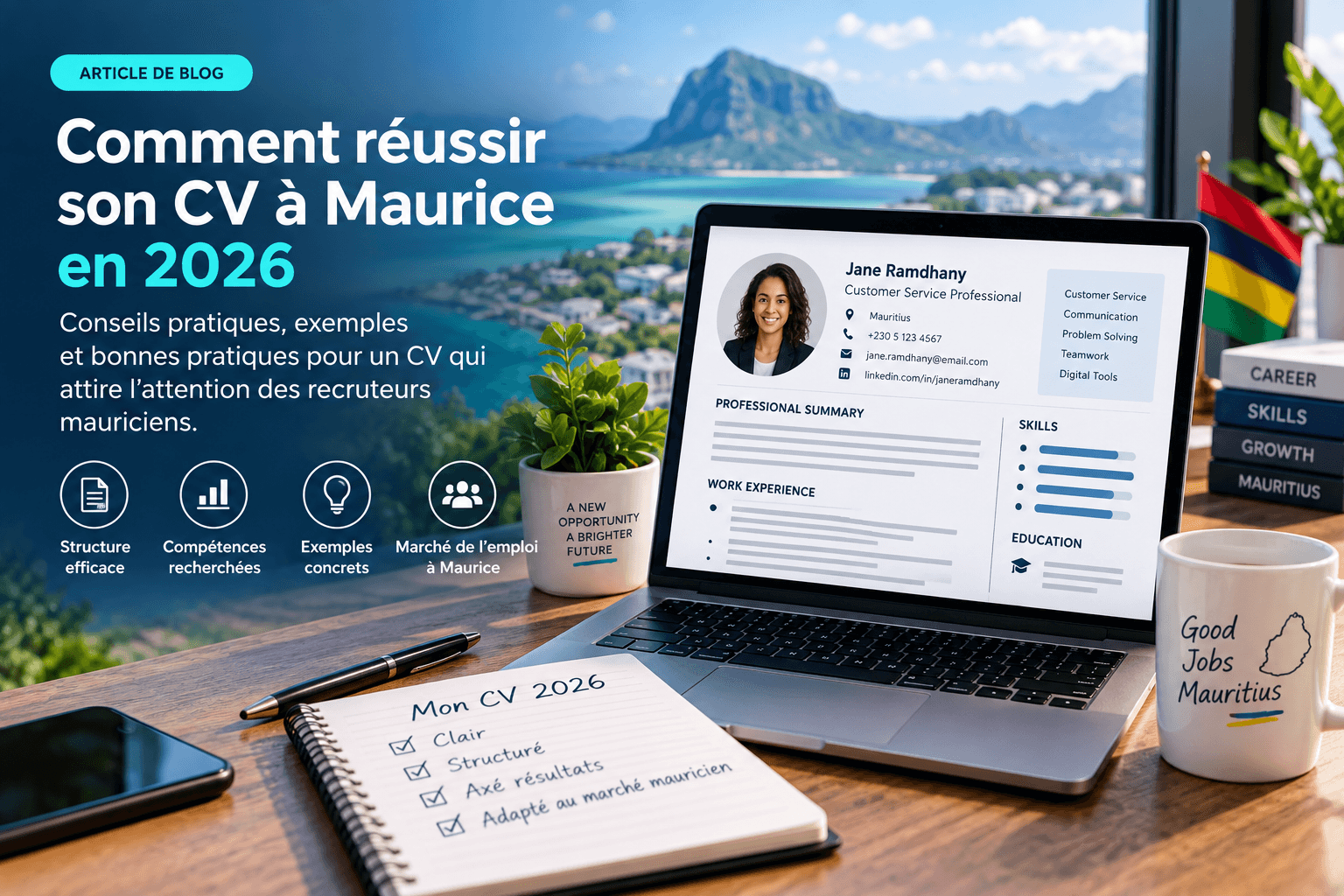
You find a job opportunity that seems perfect for you. You have the experience, the skills, and the motivation. You send your CV… and then you wait.
Sometimes, there is no response.
The problem is not necessarily your profile. It may simply be the way your experience is presented.
In 2026, a CV should no longer be just a list of your qualifications and previous jobs. It should help a recruiter quickly understand who you are, what you can do, and most importantly, what you could bring to the company.
In Mauritius, where candidates may apply to local SMEs, large groups, banks, international companies, BPOs, hospitality businesses, technology companies, or growing start-ups, having a clear and well-structured CV can make a real difference.
So, how can you improve yours?
Your CV Is Not Your Autobiography
This is probably the first thing to change in the way you think about your CV.
You do not need to tell your entire professional story.
A recruiter does not necessarily need to know every small responsibility you have had over the past 10 or 15 years. What they really want to know is whether your profile matches the position they need to fill.
Your CV should therefore answer three questions quickly:
Who are you professionally?
What are your main skills?
Why should the recruiter consider meeting you?
It sounds simple, but many CVs do not answer these questions clearly.
1. Start With a Clear Professional Title
Avoid starting your CV with:
CURRICULUM VITAE
The recruiter already knows they are reading a CV.
Use that valuable space to provide useful information instead.
For example:
HR Business Partner | Talent Management & Employee Engagement
Accounts Officer | Reconciliation • AP/AR • Excel
Customer Service Advisor | French & English | Banking
Digital Marketing Specialist | Social Media • SEO • Google Ads
Your title should reflect the type of position you are targeting.
This does not mean giving yourself a job title you have never held.
It simply means positioning your profile clearly so the recruiter immediately understands your professional direction.
2. Add a Professional Summary
Just below your contact details and professional title, include a short introduction to your profile.
Not ten lines.
Usually, four to six lines are enough.
Avoid very generic statements such as:
Motivated and hardworking individual looking for an opportunity to develop my skills.
There is nothing particularly wrong with this sentence.
The problem is that it could describe almost anyone.
Instead, consider something like:
Customer Service professional with 5+ years of experience in BPO and financial services environments. Experienced in customer relationship management, complaint resolution and KPI-driven operations. Bilingual in French and English, with strong communication and problem-solving skills.
Within a few seconds, the recruiter has a much clearer understanding of the candidate.
Your professional summary should make them want to continue reading.
3. Don't Just Describe What You Did. Show What You Achieved.
This is one of the biggest improvements you can make to a CV.
Consider this example:
Responsible for customer service.
Handling customer complaints.
Preparing weekly reports.
Assisting the manager.
None of these statements are necessarily wrong.
But they only describe the responsibilities of the position.
Now compare them with:
Managed an average of 50+ customer interactions per day while maintaining service quality standards.
Or:
Contributed to improving customer satisfaction by identifying recurring complaints and proposing corrective actions.
Or:
Prepared weekly operational reports used by management to monitor team performance and service levels.
We immediately understand more about the candidate's contribution.
When writing about your professional experience, ask yourself one simple question:
"What improved because of my work?"
It could be increased sales, shorter processing times, improved customer satisfaction, better organisation, fewer errors, successful project delivery, stronger team performance, or simply a significant volume of work managed efficiently.
Whenever you have numbers, use them.
Numbers make your experience more tangible.
4. Adapt Your CV to the Job
It is tempting to create one CV and send exactly the same document to 50 companies.
It is also one of the reasons some applications are less effective.
You do not need to completely rewrite your CV for every application.
However, take a few minutes to read the job advertisement carefully.
Look at the language used by the employer.
What skills are they looking for?
Which responsibilities appear several times?
What software or tools are mentioned?
What level of experience is required?
Then make sure that your relevant skills and experience are clearly visible on your CV.
For example, if a company is looking for someone with experience in customer relationship management, and you have that experience, the recruiter should not have to guess.
Make it visible.
5. Keep ATS in Mind
Many companies now use systems to manage and filter applications. These are commonly known as Applicant Tracking Systems, or ATS.
This does not necessarily mean that a robot decides who gets hired.
However, it does mean that overly complicated CV designs can sometimes be more difficult for recruitment systems to process.
A simple structure usually works well:
Name and Contact Information
Professional Title
Professional Summary
Key Skills
Professional Experience
Education
Certifications
Languages
You can then add relevant technical skills, software, tools, or other information depending on the position.
Avoid unnecessarily complex layouts, important information placed only inside graphics, and CVs that look more like advertising brochures than professional documents.
A beautiful CV is good.
A beautiful CV that is also clear, readable and effective is much better.
6. Highlight Skills That Actually Matter
Writing:
Microsoft Word
Internet
provides very little differentiation for many positions today.
Be more specific.
For example:
Microsoft Excel — Pivot Tables, VLOOKUP/XLOOKUP, Reporting
Power BI — Dashboards and Data Visualisation
CRM — Salesforce / HubSpot
Recruitment — Sourcing, Interviewing, Onboarding
Customer Service — Complaint Management, Retention, Upselling
Digital Marketing — Meta Ads, Google Ads, SEO
In 2026, it may also be relevant for certain positions to mention your ability to use artificial intelligence tools professionally.
But there is an important distinction.
Simply writing:
ChatGPT
does not necessarily demonstrate a professional skill.
It is more useful to explain what you can actually do with AI:
AI-assisted research and reporting
Generative AI for content production
AI-assisted data analysis
Prompt engineering
Workflow automation
Do not fill your CV with fashionable terminology simply because everyone is talking about AI.
Show what you can genuinely do.
7. Languages Can Be a Real Advantage in Mauritius
The Mauritian employment market has an interesting advantage: many professionals naturally operate in several languages.
If you speak both English and French, make this clearly visible on your CV.
For example:
English — Professional Proficiency
French — Fluent
Mauritian Creole — Native
For positions involving international clients, regional operations, tourism, BPO, financial services or multinational companies, language capabilities can be particularly valuable.
But always be realistic about your level.
If you write "Fluent English", the recruiter may decide to conduct part of the interview in English.
Your CV should always reflect reality.
8. Should Your CV Be One Page or Two?
It depends mainly on your experience.
For a student, recent graduate or candidate with limited professional experience, one page may be perfectly sufficient.
For an experienced professional, two pages are completely acceptable if the information is relevant.
The objective is not to squeeze 15 years of professional experience onto a single page.
The objective is to remove information that does not add value.
For each section, ask yourself:
"Does this information help the recruiter understand why I am suitable for the position?"
If the answer is no, consider whether it really deserves space on your CV.
9. Should You Include a Photo on Your CV in Mauritius?
There is no single answer that applies to every situation.
Photos are still used on some CVs in Mauritius, but a photo is not what makes a CV professional.
If you decide to include one, use a professional-looking photograph: simple background, good lighting, appropriate clothing and a natural head-and-shoulders composition.
Avoid selfies, holiday photographs, heavily filtered images or photographs cropped from social events.
And if you prefer not to include a photo, your CV can still be completely professional.
Your experience, achievements and skills should remain the main focus.
10. Pay Attention to the Small Details
A CV can contain excellent experience and still lose credibility because of small mistakes.
Before sending it, check:
spelling and grammar;
employment dates;
job titles;
your telephone number;
your email address;
formatting and alignment;
consistency between fonts and headings;
links to LinkedIn or your portfolio.
Also use a professional email address.
A simple combination of your first and last name is usually a safe choice.
And one more practical tip:
Save your final CV as a PDF unless the employer specifically requests another format.
Give the file a professional name too.
Instead of:
CV-final-new-version-2026-2.pdf
use something like:
Jane_Ramdhany_CV.pdf
Small details contribute to the overall impression.
11. Your LinkedIn Profile and CV Should Tell the Same Story
A recruiter interested in your application may search for your LinkedIn profile.
LinkedIn does not need to be an exact copy of your CV.
However, the main information should be consistent.
If your CV says you worked for a company from 2022 to 2025 while LinkedIn says 2021 to 2023, this can create unnecessary questions.
You can also use LinkedIn to show things that may not fit comfortably on your CV:
projects;
professional achievements;
recommendations;
certifications;
publications;
portfolio work;
or professional interests.
Think of your CV and LinkedIn profile as two parts of the same professional identity.
12. AI Can Help You Improve Your CV — But It Shouldn't Replace Your Personality
In 2026, using AI to improve a CV is no longer unusual.
AI can help you:
correct your English or French;
rewrite a professional experience;
identify important skills in a job advertisement;
improve your professional summary;
turn responsibilities into achievement-focused statements;
prepare a cover letter;
or prepare for an interview.
But there is a trap.
If you simply ask an AI tool:
"Write me a professional CV."
you may receive something polished and impressive… that sounds exactly like thousands of other AI-generated CVs.
Use AI as an assistant.
Your experience, achievements and personality must remain yours.
Most importantly, never allow AI to invent qualifications, skills, responsibilities or achievements that you do not actually have.
Your CV must remain authentic.
Before Sending Your Next CV
Take five minutes and read your CV as if you were the recruiter.
Can you understand your profession within a few seconds?
Is your level of experience clear?
Can you immediately identify your strongest skills?
Are your achievements visible?
Does the CV actually match the position?
Is it easy to read?
Are your contact details correct?
If the answer to these questions is yes, you already have a strong foundation.
But remember one important thing.
The Best CV Is Not Necessarily the Most Beautiful One
The best CV is the one that allows a recruiter to quickly understand:
"This is what this person can do. This is what they have already achieved. And this is why they could be valuable to our organisation."
Your CV does not need to be spectacular.
It needs to be clear, credible, professional and human.
Because at the end of the recruitment process, a company is not hiring a document.
It is hiring a person.
Looking for Your Next Opportunity in Mauritius?
Keep an eye on opportunities that genuinely match your experience and career goals, and take the time to adapt your application to the positions that matter to you.
Before clicking "Apply", ask yourself one final question:
If I were the recruiter reading this CV today, would I want to meet this person?
If the answer is yes, your CV is already doing a large part of its job.